
November 4, 2026 · Market Update
Midtown Market Update: October 2026
October firmed from September, and Midtown's anchor districts held their ground while the wider city kept easing.
The Short Version
Buyers returned cautiously in October. Then the Bank of Canada raised its overnight rate target by a quarter point to 2.5 per cent on October 28. Activity improved just as borrowing became more expensive.
GTA sales came in at 5,603 in October, down 7.9 per cent from a year earlier. Across all home types, the average selling price was $1,024,108, down 2.7 per cent, and the MLS Home Price Index composite fell 4.3 per cent. On a seasonally adjusted basis, sales, new listings, the composite and the average price all edged up from September. The GTA average blends two very different markets: detached homes averaged $1,310,627, down 3.2 per cent, while condo apartments averaged $621,400, down 5.8 per cent.
In the City of Toronto, 2,184 homes sold at an average of $1,075,627 on 5,451 new listings (TRREB Market Watch, October 2026). Detached homes averaged $1,603,886, down 1.2 per cent, on 741 sales that were up 0.5 per cent year over year. Condo apartments averaged $659,214, down 5.6 per cent, on 949 sales that were down 10.7 per cent. Houses are holding. Condos are carrying the decline.
Midtown continued to hold firmer than the city around it, as it has all year. Confidence still determines what happens next. The rate increase makes that confidence more expensive to act on.
Midtown by District
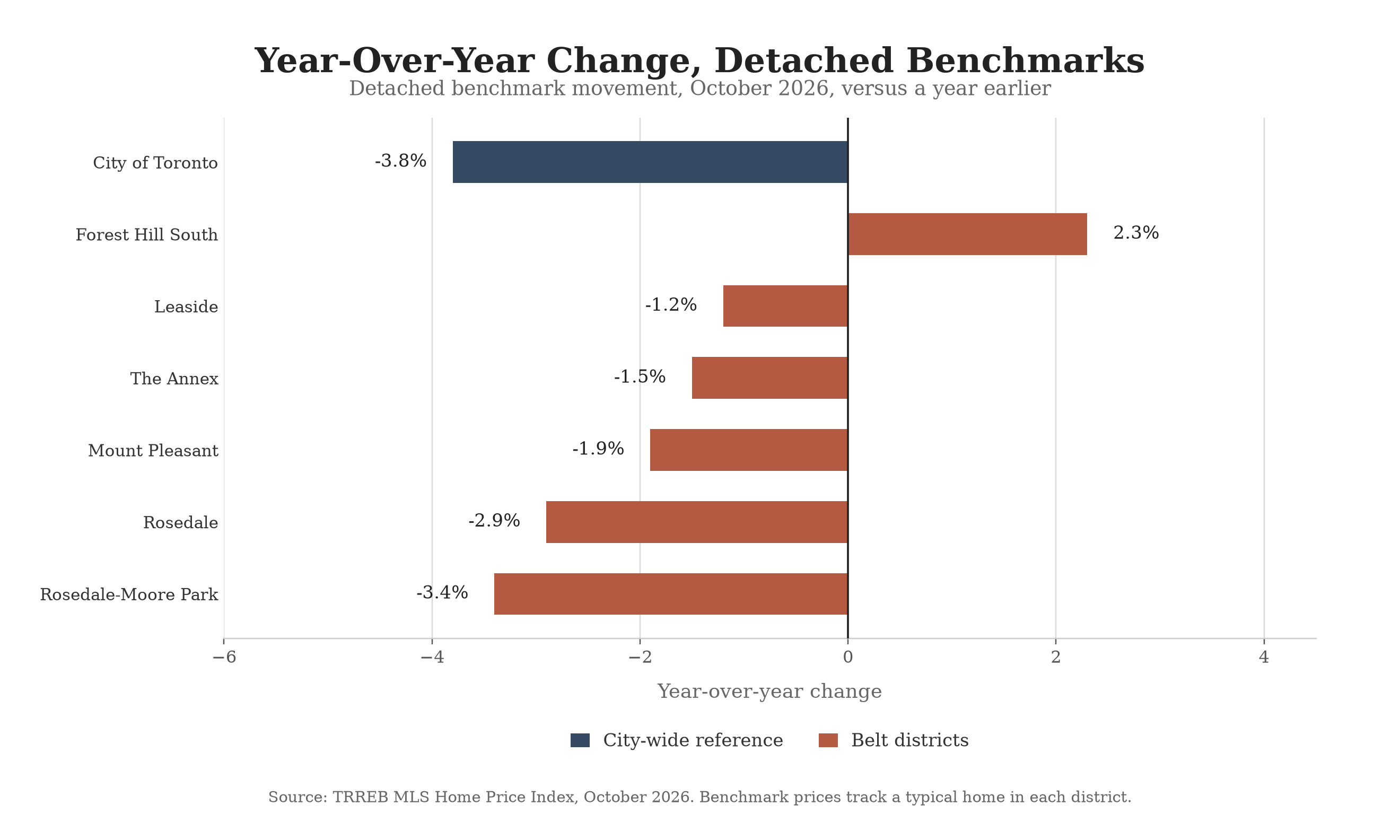
In the City of Toronto, the composite benchmark across all home types sat at $908,800, down 3.6 per cent from last October. The detached benchmark was $1,422,800, down 3.8 per cent.
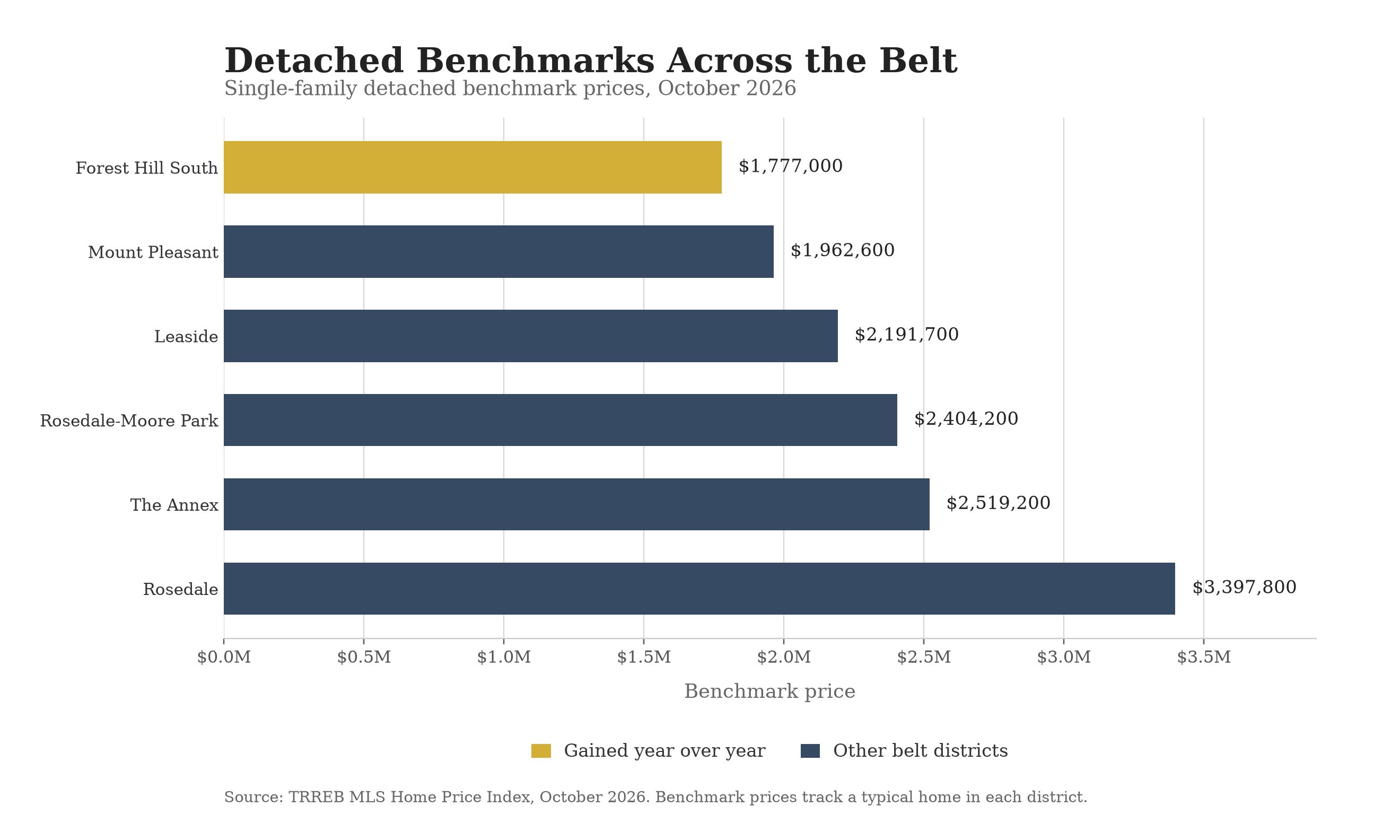
Inside the belt, detached benchmarks year over year:
- Rosedale: $3,397,800, down 2.9%
- The Annex: $2,519,200, down 1.5%
- Rosedale-Moore Park: $2,404,200, down 3.4%
- Leaside: $2,191,700, down 1.2%
- Mount Pleasant: $1,962,600, down 1.9%
- Forest Hill South: $1,777,000, up 2.3%
Every district in the belt outperformed the city's 3.8 per cent detached decline. Forest Hill South posted the only gain, up 2.3 per cent. On the composite measure, Mount Pleasant rose 3.2 per cent and Leaside rose 0.2 per cent, against a city composite down 3.6 per cent.
The sales counts matter. The Annex set its detached benchmark on nine sales and Mount Pleasant on eleven. With so few transactions, a monthly reading can look more decisive than the market feels on the ground. Read each district against its own trend, not in isolation.
Behind the Numbers
New listings came in at 14,173, down 11.9 per cent from a year earlier, and active listings fell 10.0 per cent to 25,098. Buyers held back. Owners held back more. A slower market did not give buyers the wider choice they might have expected.
Few owners are being forced out. GDP grew 3.3 per cent in the second quarter and about 2 per cent in the third (Bank of Canada), and Toronto employment grew 2.1 per cent year over year in September (TRREB Market Watch, October 2026). Sellers are choosing when to move, rather than being forced to sell.
Borrowing costs moved in the other direction. On October 28, the Bank of Canada raised its target for the overnight rate by 25 basis points to 2.5 per cent. Inflation has run around 3 per cent since April, and the Bank expects about 3.5 per cent by year end, driven by energy prices and businesses passing on costs. The Bank said a further increase could still be needed, but it will proceed carefully.
TRREB President Daniel Steinfeld points to a Canada-US trade deal and a resolution to the conflict in the Middle East as the two developments that would reduce uncertainty around inflation and the economy, strengthen confidence, and bring buyers back to homeownership through 2027.
For Buyers
The apartment benchmark shows where buyers have the most room to negotiate: down 7.3 per cent year over year across the GTA at $521,600, and down 7.0 per cent to $540,100 in the City of Toronto. Condominiums remain the softest segment. Sellers there know it.
Freehold is different. In the belt, detached benchmarks held within a point or three of flat, and Forest Hill South gained. A broad market decline is not your strongest negotiating argument in Midtown houses. The opportunity depends on the individual seller, not the city headline.
TRREB Chief Information Officer Jason Mercer notes that buyers have retained substantial negotiating power, with lower selling prices offsetting the rise in borrowing costs. TRREB adds that monthly payments on an average-priced home, while higher than a year ago, remain much more affordable than the payments buyers faced in 2023 and 2024. The rate increase trims pre-approvals at the margin. October's lower prices provide some offset.
For Sellers
Average listing days on market sat at 31, the same as last October, and property days on market came in at 49, one day fewer than a year earlier. Homes priced for this month are trading in about a month. Homes priced for last year are sitting.
There is also less fresh competition. New listings fell 11.9 per cent, and the buyers still walking through tend to be serious. A well-priced house can stand out more clearly when fewer properties are coming to market.
Forest Hill South detached posted the belt's only gain at 2.3 per cent. Demand for a good house in the right district remains. That is a reason to price carefully, not to test how far a buyer will stretch.
What I'm Watching
December 9 is the Bank of Canada's next rate decision, and another increase remains possible. That decision, followed by the next Monetary Policy Report on January 27, will set the tone for the winter market.
The fall listing trend matters just as much. New listings remain 11.9 per cent below last year, even though seasonally adjusted listings rose from September. If owners keep waiting, spring opens with less to choose from. That would support prices where they are already holding.
Closer to home, I am watching whether the belt's October steadiness repeats. Forest Hill South turned positive, Mount Pleasant and Leaside turned positive on the composite measure, and all six districts outperformed the city's detached decline. One more month like that would give the trend more weight.
The Bottom Line
October firmed from September. The belt held. December will test whether that steadiness can continue with higher borrowing costs.
Buyers have negotiating power in condos and face firmer pricing in Midtown houses. Sellers have less competition, but still need to get the asking price right. Neither side has certainty. Both can make a decision based on the market in front of them.
The numbers above are district-level. The right number for any given block is still a conversation.
Sources: TRREB Market Watch, October 2026; Bank of Canada.